Salim’s Wheelchair Story: A Hope That Death Couldn’t End
08 August 2025
Can a wheelchair carry more than one body? Can it carry a memory, a hope, and perhaps a longing that outlives death?
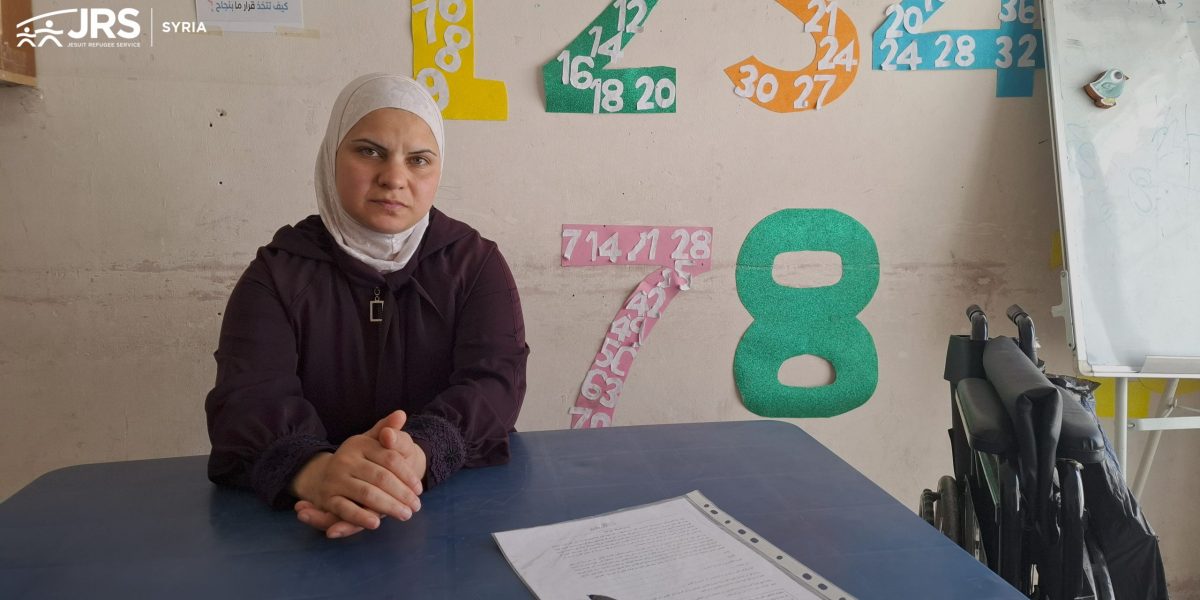
This is exactly what happened in one of Aleppo’s eastern neighborhoods. At the JRS medical center in Al Helluk, a mother walked in carrying a small wheelchair, along with the memory of her son, Salim, who had passed away just days earlier after a long journey of pain and perseverance.
Salim’s Childhood in the Shadow of War
Salim was born in 2008. He was a bright, curious child who loved learning. He lived with his parents, four sisters, and older brother in the Martini neighborhood of Aleppo. Education was a priority in the family. His siblings pursued studies in engineering, languages, and technical fields.
In 2013, as the war intensified in Aleppo, shells fell near their home. Salim was injured when he fell during the explosions, suffering a brain contusion. He was only five years old. That moment marked the beginning of a long medical journey. Doctors diagnosed him with early muscular dystrophy, followed by leg deformities, spinal curvature, osteoporosis, and eventually diabetes. Over time, he lost the ability to breathe on his own.
The family continued his treatment at the Helluk center, receiving regular medications and medical aids like back braces. But his condition worsened, and he needed a ventilator. The family tried to admit him to several public hospitals, but they were turned away due to the severity of his case. They also could not afford the cost of admission to a private hospital.
His mother recalls: “I felt like every door had closed in my face. There was no savior for my son but prayer.”
When they returned home, Salim was struggling to breathe. The oxygen tank had run out. His father rushed to get a new one. When he returned, he found Salim awake, surrounded by his mother and siblings. Salim asked them to recite his favorite surah from the Qur’an. Later that night, at the age of 17, Salim passed away.
The Wheelchair That Arrived Just in Time
The next day, his mother returned to the Helluk center and handed over Salim’s wheelchair to Dr. Mohammad Al-Masri, the center’s lead doctor. She said calmly and with trust: “I know you’ll give it to someone who truly needs it. All I ask is that you pray for my son to be in a better place.”
She knew the chair would serve someone else, someone who might find relief from the same suffering her son had endured.
At the JRS center in Al Sakhour neighborhood, a woman named Amina came in to collect her mother’s regular medications. Her mother had suffered a stroke six months earlier, leaving her paralyzed on the right side. Dr. Rehab Al-Bari, the center’s lead doctor, asked Amina to bring her mother in for an initial medical assessment. Amina replied:
“My mother is bedridden, and we don’t have a wheelchair to move her. When I absolutely must take her somewhere, I call an ambulance. But if I had a wheelchair, I’d try to bring her.”
Dr. Rehab responded, “Wait a moment.”
She immediately called the Helluk center to ask about the wheelchair. That was yesterday. Today, Amina received the chair.
Amina said: “This wheelchair will make a real difference in my mother’s life. I can now take her outside, accompany her on short visits, and help her feel some of the movement she’s missed for months.”
Through her accompaniment, Dr. Rehab also helped Amina apply for the “blue card” from the Ministry of Social Affairs, a disability card that provides certain benefits like reduced transportation and healthcare costs. Amina hadn’t known such a card existed. Now, she has it, and with it, a way to support her mother and a renewed sense of hope.
When Trust Meets Compassion
This story is not just about a medical device. It’s about the trust that JRS health programs have built over time. A grieving mother donated what remained of her son’s journey, confident that it would reach someone in need. And a woman like Amina found not only a wheelchair, but someone who listened, responded, and offered more than she expected.
In a world full of pain, it’s stories like these that restore the meaning of humanity, the presence of compassion, and the power of hope.
Note: Names of individuals have been changed to protect their privacy.
Explore more